
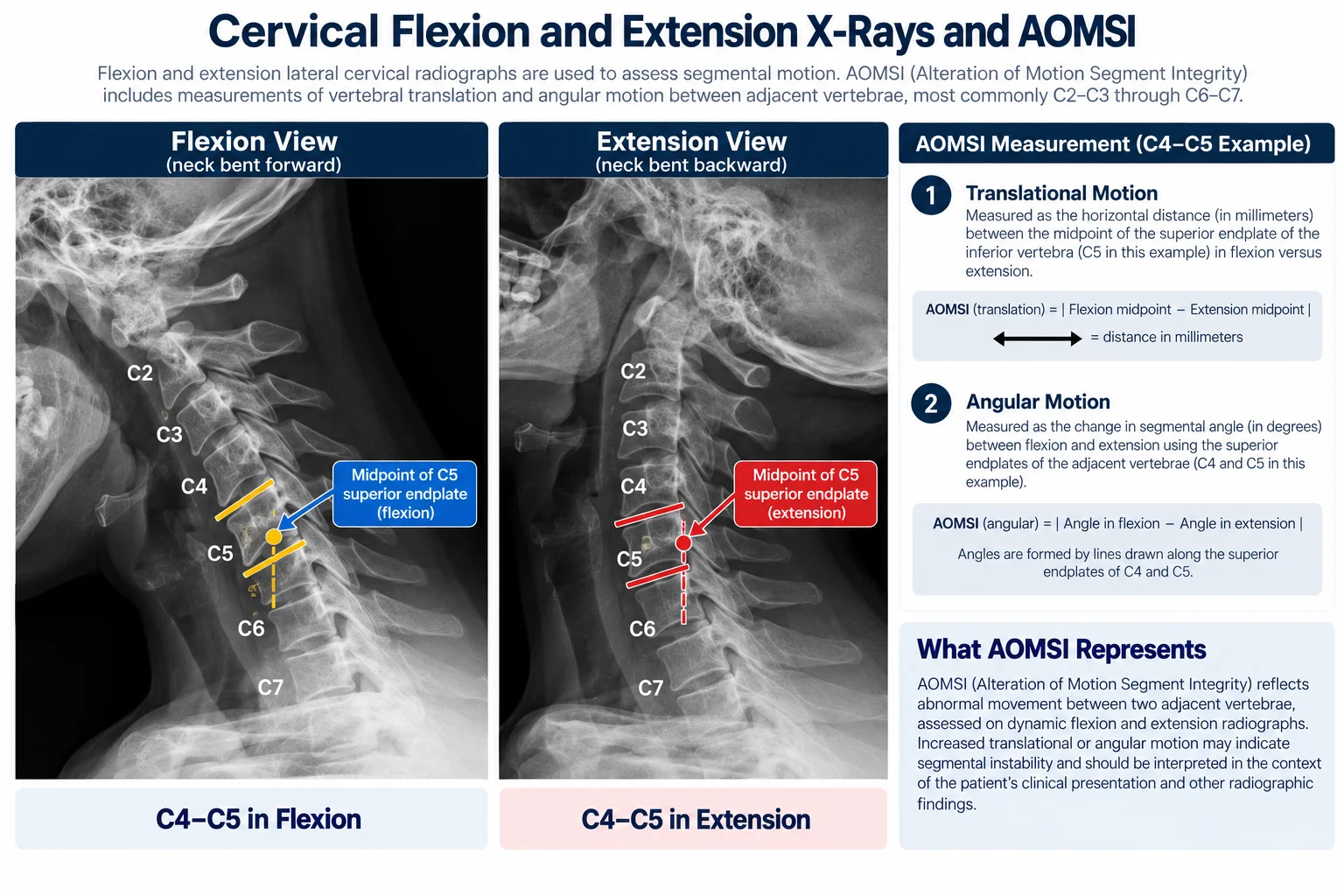
After a car accident, a lot of people end up with neck pain and headaches that are hard to explain on a standard X-ray. The images come back and the doctor says everything "looks normal," but you still can't turn your head without pain. That disconnect is frustrating, and it's more common than you might think. One of the most useful tools for closing that gap is an AOMSI exam, a specialized cervical spine study that goes well beyond a routine X-ray.
What Is AOMSI?
AOMSI stands for Alteration of Motion Segment Integrity. It's a measurement-based diagnostic protocol used to evaluate how individual spinal segments in the neck are moving, or more accurately, how they're moving abnormally. Ligament damage from whiplash often doesn't show up on standard imaging, but it does show up when you measure the precise motion between vertebrae under stress.
The exam involves a series of flexion and extension X-rays, meaning images taken while you bend your neck forward and backward. From those images, a trained clinician measures the translation (forward or backward slip) and angular motion at each spinal level. These aren't eyeball estimates. They're precise measurements compared against established normal values.
How It Follows AMA Guidelines
The AOMSI protocol is grounded in the AMA Guides to the Evaluation of Permanent Impairment, the same reference used by physicians and legal professionals across the country to assign impairment ratings. According to those guidelines, a cervical spinal segment showing more than 3.5 mm of translational motion or more than 11 degrees of angular motion beyond what's normal at that level is considered evidence of altered motion segment integrity. When those thresholds are met, the injury can be rated and documented as a measurable, permanent impairment.
That's significant. It means an AOMSI finding isn't just a clinical note. It's a standardized, reproducible measurement with a recognized framework behind it.
What the Exam Is Looking For
In a healthy cervical spine, each vertebra moves in a predictable, controlled way relative to its neighbor. After an acceleration/deceleration injury like whiplash, the ligaments that stabilize those segments can be stretched or torn. When that happens, the segment starts moving in ways it shouldn't. It may shift too far forward, open too wide, or rotate excessively.
The AOMSI study evaluates each cervical level independently, looking for:
- Translational abnormality: How far one vertebra slides relative to the one above or below it, measured in millimeters.
- Angular abnormality: How much the angle between adjacent vertebrae changes during flexion or extension, measured in degrees.
- Segmental instability patterns: Motion that suggests the ligamentous support of a specific level has been compromised.
When findings at a given level exceed the AMA thresholds, it provides objective evidence of ligament damage at that specific location in the spine. That kind of specificity is something a general X-ray or even an MRI at rest simply cannot provide.
How We Perform This Exam at Our Office
We perform AOMSI studies right here in our Lexington office. Our digital X-ray suite allows us to capture high-quality flexion and extension cervical images without sending you to a separate imaging facility. Once those images are taken, Dr. Pelphrey analyzes them using Spinal Kinetics software, a specialized program designed specifically for this type of measurement-based spinal analysis.
Spinal Kinetics generates a comprehensive report that documents the findings at each cervical level, including all translational and angular measurements alongside the established AMA thresholds. That report is produced for Dr. Pelphrey's clinical use, and copies are also available for the patient, their insurance carrier, and their attorney. Everything is in one standardized, professional document that clearly communicates the findings and their significance.
When the clinical picture warrants it, Dr. Pelphrey will also order MRI imaging. While the AOMSI study captures dynamic motion under stress, an MRI provides detailed soft tissue information, including disc integrity, nerve involvement, and other structural findings that a dynamic X-ray study isn't designed to show. Together, these tools give us a thorough picture of what's happening in the cervical spine after a collision.
Why It Matters Clinically
From a treatment standpoint, knowing exactly which cervical levels are unstable changes everything. The Spinal Kinetics report gives Dr. Pelphrey an accurate, evidence-based diagnosis to work from, not a best guess. That means care can be tailored to protect the injured segment, avoid aggravating it during adjustments, and focus rehabilitation on the muscles and supporting structures that need to compensate for compromised ligaments. Without this level of diagnostic detail, treatment decisions are essentially educated estimates.
Neck pain and headaches after a car accident in Lexington, Kentucky are extremely common, and most people assume they'll just get better on their own. Sometimes they do. But when ligament damage is the underlying issue, those symptoms tend to linger or come back unless the actual injury is identified and addressed. An AOMSI study helps us understand what we're actually dealing with so we can make a real plan.
You can learn more about the services we provide for car accident and whiplash patients at pelphreychiropractic.com/services.
Why It Matters in a Legal Setting
If you're working with an attorney on a personal injury claim after a car accident, documentation is everything. Insurance companies routinely challenge soft tissue injuries because they're hard to quantify. "My neck hurts" is easy to dismiss. A measured AOMSI finding that exceeds AMA impairment thresholds is not.
The Spinal Kinetics report gives attorneys and insurance adjusters a concrete, standardized measurement with an established impairment rating. It ties your symptoms directly to a specific, objectively documented injury at a specific spinal level, caused by the mechanism of the accident. That kind of evidence holds up. It also helps ensure that any settlement or award reflects the actual severity of the injury rather than a generic estimate.
Many personal injury attorneys in Kentucky are already familiar with AOMSI findings and specifically request them for their clients involved in motor vehicle accidents.
Who Should Consider an AOMSI Exam?
If you've been in a car accident and you're experiencing neck pain, headaches, stiffness, or any neurological symptoms like tingling in your arms, an AOMSI study is worth discussing with your chiropractor. It's especially relevant if standard imaging has come back unremarkable but your symptoms haven't resolved. That pattern is often a sign that ligament damage is present and simply hasn't been properly evaluated yet.
Getting an accurate diagnosis early protects both your health and your legal rights. Waiting months before seeking thorough documentation can make it harder to connect your injuries to the accident.
If you're in Lexington, Kentucky and you've been in a collision, reach out to us to talk through your options. We're happy to walk you through what an AOMSI exam involves and whether it makes sense for your situation. Visit our contact page to get in touch.